

What if your marketing budget could evolve as fast as the algorithms that spend it? Essentially, a data-driven marketing strategy is a technical framework using real-time insights and algorithmic analysis to optimize brand performance. Specifically, this methodology eliminates fragmented data silos and integrates AI-driven search behaviors to ensure measurable growth in lead quality.
Consequently, your brand moves from guessing to precise execution. You likely feel the frustration of watching ad spend vanish into fragmented channels where the customer journey remains a mystery. In fact, many businesses still struggle to bridge the gap between raw data and actionable growth. DNA Digital Marketing has spent 15 years proving that a data-driven marketing strategy is the core of your brand’s evolution.
Instead of chasing trends, we focus on the underlying mechanics of business success. This blueprint provides the exact formula to master AI Search and Generative Engine Optimization for the 2026 landscape. Ultimately, you’ll learn to build a scalable framework that thrives on technical depth and strategic precision.
Key Takeaways
- Learn why merging analytics with creative execution is the only way to evolve your brand beyond old tactics.
- Identify three data pillars to build a high-performance data-driven marketing strategy that integrates with your CRM.
- Discover how to optimize brand data for the shift from traditional SEO to Generative Engine Optimization.
- Follow our two-step blueprint to audit your data landscape and define clear KPIs that drive real growth.
- Understand how partnering with an expert like DNA Digital Marketing bridges the gap between sales and marketing.
What is a Data-Driven Marketing Strategy in 2026?
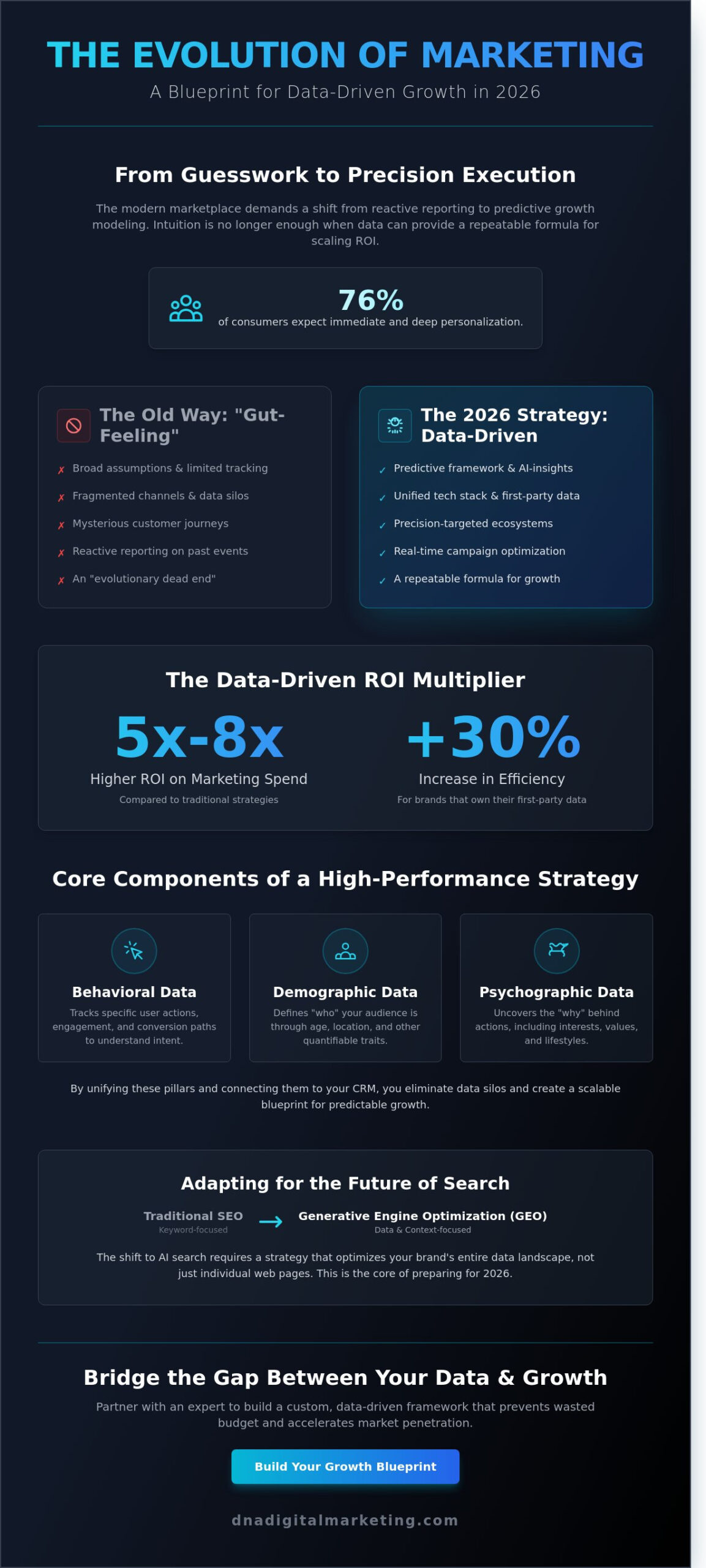
A data-driven marketing strategy in 2026 is a predictive framework that synthesizes advanced analytics with creative execution to drive measurable business growth. This approach leverages first-party data and AI-driven insights to replace traditional intuition with a repeatable formula for scaling ROI. Consequently, businesses can automate complex decision-making processes while maintaining a personalized connection with their target audience.
Traditional marketing often relies on broad assumptions. Because market dynamics change rapidly, the “gut-feeling” model has become an evolutionary dead end. Modern brands must instead identify their marketing DNA. This represents the fundamental data code that determines how a brand interacts with its audience. Therefore, shifting from reactive reporting to predictive growth modeling is essential for survival. This evolution ensures your brand remains agile in a volatile economy where 76% of consumers expect immediate personalization.
To better understand how these foundations work in the current market, watch this helpful video:
The Difference Between Traditional and Data-Centric Approaches
Old-school strategies focus on broad-reach media with limited tracking capabilities. Conversely, a data-centric Marketing strategy creates precision-targeted digital ecosystems. These systems utilize real-time feedback loops to optimize campaigns instantly. Specifically, 2026 requires a total commitment to first-party data ownership. Because privacy regulations have tightened, businesses must build their own data reservoirs. Consequently, brands that own their data see a 30% increase in efficiency compared to those relying on external sources.
Why Your Business Needs a Strategic Blueprint
These repeatable formulas provide a clear path for scaling ROI. Without a blueprint, companies often drift without direction or measurable goals. DNA Digital Marketing leverages over 15 years of strategic expertise to build these custom frameworks. Because the marketplace is now data-saturated, the cost of inaction is high. For instance, companies using data-driven insights see five to eight times the ROI on their marketing spend. Specifically, our digital marketing services focus on creating these high-performance blueprints to prevent wasted budget and accelerate market penetration.
Frequently Asked Questions
What defines a data-driven marketing strategy in 2026?
It is a predictive system that uses real-time analytics and first-party data to guide creative and tactical decisions.
Why is “gut-feeling” marketing failing now?
Consumer behavior is too complex for intuition; therefore, businesses need precise data to match the 76% of consumers demanding personalization.
How does predictive growth modeling work?
Predictive modeling uses historical data and AI to forecast future trends, allowing brands to act before market shifts occur.
What is marketing DNA?
Marketing DNA is the core data profile of a brand that dictates its unique growth patterns and audience interactions.
Why is first-party data ownership critical?
With the decline of third-party cookies, owning your data ensures you retain control over your audience insights and campaign accuracy.
#DataDrivenMarketing #MarketingStrategy2026 #DigitalGrowth #PredictiveAnalytics #SEO #AEO #DNADigitalMarketing
DNA Digital Marketing provides specialist expertise in SEO, AEO, GEO, and digital marketing for small to medium-sized companies seeking a proven blueprint for growth.
What Are the Core Components of a High-Performance Data Strategy?
A high-performance data-driven marketing strategy integrates behavioral, demographic, and psychographic data into a unified tech stack. By connecting CRM data with advertising platforms and removing organizational silos, businesses create a scalable blueprint for predictable growth. This approach ensures every marketing dollar fuels measurable results through precision targeting and rapid evolution.
Building a robust strategy requires three primary pillars. Behavioral data tracks specific actions like website visits, email clicks, or purchase history. Demographic data identifies the “who” by cataloging age, location, and job titles. Psychographic data reveals the underlying motivations, values, and interests of your audience. Consequently, combining these three segments allows you to build a comprehensive customer profile that goes beyond surface-level traits. This holistic view is the fundamental core of your marketing DNA.
Successful execution depends on your tech stack. You must connect your CRM directly to your advertising channels to synchronize audience lists in real time. This integration ensures your ads reach the right people during critical decision moments. However, this only works if your data remains clean. Inaccurate records lead to wasted spend; therefore, regular data hygiene is essential for maintaining a competitive edge. Industry leaders often cite the advantages of data-driven decision-making as the primary driver for high-growth firms. By removing silos between sales and marketing, you ensure that insights flow freely across the entire organization.
First-Party Data: The Core of Your Brand DNA
Privacy regulations and the decline of third-party cookies have fundamentally changed the digital environment. Consequently, your brand must prioritize first-party data collection to maintain visibility. This information comes directly from your interactions with customers, making it highly accurate and compliant. You can gather these insights through newsletter signups, gated content, or loyalty programs. Because you own this data, it becomes a permanent asset for your business. This shift is a critical component of the digital marketing trends for 2026.
Analytics and Attribution Modeling
Modern buyers interact with brands across multiple channels before completing a purchase. Multi-touch attribution (MTA) assigns specific value to every interaction in that journey. This model helps you identify invisible touchpoints, such as a podcast mention or a social media share, that influence the final sale. Instead of guessing, you use hard numbers to optimize your budget allocation. Within this framework, ROI is the mathematical proof of marketing efficiency measured by the ratio of net profit to total investment.
Expert Q&A
Q: How does clean data impact my advertising costs?
A: Clean data reduces waste by ensuring your ads target active, relevant leads rather than outdated or duplicate contacts, which lowers your cost per acquisition.
Q: What is the most important data pillar for 2026?
A: Behavioral data is paramount because it reflects real-time intent and actual consumer actions rather than static characteristics.
Q: How do I break down organizational data silos?
A: You must integrate your various software tools into a centralized source of truth, such as a robust CRM, that all departments can access.
Q: Why is third-party data becoming less reliable?
A: Increased privacy regulations and browser changes have limited the accuracy and availability of third-party tracking cookies, making them less effective for targeting.
Q: What defines a high-performance tech stack?
A: A high-performance stack includes integrated tools for CRM, analytics, and automation that communicate seamlessly to drive repeatable growth.
#DataDrivenMarketing #DigitalStrategy2026 #MarketingROI #FirstPartyData #BusinessGrowth #DNADigital #AEO
DNA Digital Marketing provides specialist expertise in SEO, AEO, GEO, and digital marketing for small to medium-sized companies seeking a data-backed blueprint for long-term success.
How Does Generative Engine Optimization (GEO) Change Data Strategy?
Generative Engine Optimization (GEO) transforms how brands interact with search by prioritizing AI-cited authority over traditional blue links. This shift requires a data-driven marketing strategy that emphasizes structured data and entity-based content to ensure LLMs recommend your business. By optimizing for answer engines, you secure your brand’s role as a primary source in the AI-driven ecosystem.
Traditional search results are fading quickly. LLMs like GPT-5 and Gemini now synthesize information directly on the page for the user. Because of this, industry data suggests that 60% of searches may result in zero clicks by 2026. Your data must be digestible for these engines. They prioritize brands with clear digital footprints and verified expertise. DNA Digital Marketing views this shift as a biological evolution of the web. We build your brand’s core identity into the very fabric of AI training sets. Instead of chasing clicks, we focus on becoming the definitive answer.
AEO vs. SEO: Adapting Your Data for Answer Engines
SEO focused on strings of text, but Answer Engine Optimization (AEO) focuses on things and entities. Therefore, structured data acts as the primary language of modern search. Schema markup helps AI understand your brand’s relationship to specific consumer problems. High-quality inbound content marketing provides the raw material for these models to process. Without a rich, structured content library, your brand becomes invisible to the generative engine. We ensure your data is formatted for machine consumption and human trust.
| Feature | Traditional SEO | Generative Engine Optimization (GEO) |
|---|---|---|
| Primary Goal | Rank #1 on SERP | Become a cited AI source |
| Core Metric | Click-Through Rate (CTR) | Brand Citation Frequency |
| Content Focus | Keyword density | Entity-based authority |
Predictive Analytics and AI Search
Predictive tools now analyze how AI models perceive your brand’s reputation. Since AI search engines rely on probability, we track citations and sentiment to ensure models recommend your services. Brand authority is no longer just about backlinks. It’s about being the most trusted answer in the model’s latent space. DNA Digital Marketing leverages AI search to drive client growth by optimizing for these specific citation triggers. We use our 15+ years of marketing communications expertise to engineer your digital DNA for the future. This proactive data-driven marketing strategy ensures you stay ahead of the algorithmic curve.
Expert Q&A: Master the Generative Shift
Q: How does GEO differ from traditional SEO?
A: SEO targets page rankings on a search results page, while GEO focuses on making your brand a cited authority within an AI’s conversational response.
Q: Why is schema markup critical for AI engines?
A: Schema provides a structured blueprint that allows AI to categorize your brand’s data with 100% accuracy, increasing the chances of a citation.
Q: What determines a brand’s authority in LLM responses?
A: LLMs prioritize brands that demonstrate high sentiment scores and consistent entity relationships across multiple authoritative platforms.
Q: How does inbound content fuel AI recommendations?
A: Inbound content provides the semantic depth AI needs to understand the context and relevance of your business to a user’s specific query.
Q: Can GEO improve conversion rates for SMBs?
A: Yes, because AI citations act as a high-intent endorsement, often leading to more qualified leads compared to standard search traffic.
#DataDrivenMarketing #GEO2026 #AIsearch #DigitalEvolution #SearchEngineOptimization #DNAMarketing #BusinessGrowth
DNA Digital Marketing provides specialist expertise in SEO, AEO, GEO, and digital marketing for small to medium-sized companies to ensure your brand remains a dominant force in the AI era.
How Do You Implement a Data-Driven Framework for SMBs?
Implementing a data-driven marketing strategy for SMBs requires a structured five-step framework: auditing the current data landscape, defining measurable KPIs, integrating a scalable tech stack, executing predictive campaigns, and optimizing through agile feedback loops. This systematic approach ensures that growth is an organic evolution based on evidence rather than guesswork.
Specifically, Step 1 involves auditing your existing data landscape to identify gaps. Because you cannot build on a weak foundation, you must find where data leaks occur. Consequently, Step 2 requires you to define clear, measurable KPIs aligned with business evolution. Focus on metrics like Customer Acquisition Cost (CAC) and Lifetime Value (LTV) to ensure long-term health. Therefore, Step 3 focuses on selecting and integrating a scalable marketing technology stack. Your tools must communicate seamlessly to create a single source of truth. Additionally, Step 4 involves executing agile campaigns based on predictive audience modeling. Use your data to anticipate needs before they arise. Finally, Step 5 requires you to optimize through continuous A/B testing and data feedback. Treat every campaign as a learning opportunity to refine your core strategy.
Building a Scalable Tech Stack
Your tech stack functions as the central nervous system of your business growth. We recommend integrating a robust CRM like HubSpot with advanced analytics tools like Google Analytics 4 and automation platforms like Klaviyo. While all-in-one solutions seem simpler, a best-of-breed approach often provides deeper functionality for specific growth stages. Drawing on our 15+ years of marketing communications expertise, we know that technical silos stunt evolution. Instead of juggling disconnected platforms, many high-growth firms now hire a virtual marketing team to manage these complex integrations. This ensures your systems remain synchronized as you scale.
The Agile Optimization Loop
High-growth brands rely on a “Test, Learn, Evolve” cycle to maintain momentum. This loop turns raw data into actionable intelligence. Conversion Rate Optimization is an organic process of refining user experiences to maximize the value of every visitor. Follow this monthly checklist for strategy pivots:
- Review conversion rates across all digital channels.
- Identify the lowest-performing customer touchpoint.
- Formulate a specific hypothesis for improvement.
- Run a controlled A/B test for at least 14 days.
- Document results and update your baseline blueprint.
Expert Q&A
AI Search prioritizes context over keywords; therefore, brands must provide structured data that machines can easily interpret.
What is the main difference between SEO and Generative Engine Optimization?
SEO focuses on ranking, while Generative Engine Optimization ensures your brand is cited within AI-generated responses.
Why should SMBs prioritize first-party data in 2026?
Because privacy regulations and the decline of third-party cookies make direct customer relationships the only reliable source for accurate modeling.
Can predictive modeling work for businesses with smaller datasets?
Yes, because even limited data can reveal behavioral patterns that allow for more efficient ad spend and personalized messaging.
When should a business move from an all-in-one to a best-of-breed tech stack?
Transition once your current platform limits your ability to customize the customer journey or fails to integrate with specialized analytical tools.
#DataDrivenMarketing #GrowthMarketing #SMBScaling #MarketingTech #SEO2026 #DigitalEvolution #DNAStrategy
DNA Digital Marketing provides specialist expertise in SEO, AEO, GEO, and digital marketing for small to medium-sized companies to ensure your brand remains sticky in a competitive market.
Why Partnering with a Data-Centric Agency Evolves Your Brand?
Partnering with a data-centric agency transforms your brand by replacing guesswork with a precision-engineered data-driven marketing strategy. This collaboration ensures your business adapts to AI search shifts while aligning sales and marketing goals for sustainable revenue growth. Because data provides a clear roadmap, your brand evolves from a market participant to a dominant force.
Most businesses treat marketing as a series of disconnected tasks. However, a standard vendor simply executes orders while an Expert Partner architects a future. DNA Digital Marketing functions as an organic extension of your team. We bring 15 years of technical experience to your core operations. We don’t just run ads; we engineer growth. Consequently, we bridge the gap between sales and marketing silos that often hinder 74% of potential conversions. By unifying your lead data with sales performance, we ensure every campaign feeds your bottom line directly.
Expertise in modern search landscapes is non-negotiable in 2026. Specifically, we specialize in Search Engine Optimization, Answer Engine Optimization (AEO), and Generative Engine Optimization (GEO). These technical disciplines allow your brand to appear in AI-generated summaries and voice search results. Therefore, your digital presence remains visible where consumers actually spend their time. This specialized approach creates a long-term competitive advantage that competitors cannot easily replicate. Instead of chasing trends, you lead the market through technical precision.
The DNA Digital Formula for Success
Our methodology relies on a customized formula rather than a generic template. Since every business has unique goals, we build repeatable growth systems tailored to your specific market. Because we prioritize measurable results, you can track every dollar spent against tangible ROI. Instead of waiting for market shifts, we use predictive analytics to stay ahead. To see your specific path to scale, you should schedule a consultation for a custom blueprint.
Future-Proofing Your Marketing DNA
Evolution is the only constant in the 2026 digital landscape. Therefore, a data-driven marketing strategy must become a fundamental trait of your business identity. We help you integrate this intelligence into your core operations. This ensures your brand survives and thrives as AI search continues to disrupt traditional channels. Finally, your success depends on choosing a partner who understands the science of the sale. We ensure your marketing DNA is built for performance.
Expert Q&A
- How does Generative Engine Optimization (GEO) differ from traditional SEO? Traditional SEO focuses on ranking in list-based search results, whereas GEO optimizes content for AI models to synthesize and cite your brand within conversational answers.
- Why is sales and marketing alignment essential for a data-driven marketing strategy? Alignment prevents wasted spend on low-quality leads. Data integration ensures marketing targets the specific profiles that the sales team closes at the highest rates.
- What role does Answer Engine Optimization (AEO) play in 2026 search trends? AEO prioritizes concise, factual responses that satisfy zero-click queries. This ensures your brand remains the primary source for AI-powered voice and text assistants.
- How does DNA Digital Marketing define an Expert Partner? An Expert Partner moves beyond task execution to provide high-level strategic consulting. We integrate 15 years of data and technical proficiency directly into your business growth blueprint.
- Can a data-driven strategy provide a permanent competitive advantage? Yes, because it builds a proprietary intelligence asset. While competitors guess, your brand utilizes historical data and predictive modeling to dominate market shifts.
#DataDrivenMarketing #GrowthBlueprint #AISearch #DigitalEvolution #SEO2026 #MarketingStrategy #DNADigital
DNA Digital Marketing provides specialist expertise in SEO, AEO, GEO, and digital marketing for small to medium-sized companies to ensure your brand evolution is both measurable and permanent.
Secure Your Future with a Proactive Growth Blueprint
The 2026 landscape demands a decisive shift from reactive tactics to a proactive data-driven marketing strategy. Instead, success now hinges on mastering Generative Engine Optimization (GEO) to capture high-intent AI search traffic. Additionally, small businesses must prioritize high-performance data frameworks that transform raw metrics into actionable growth blueprints. Because consumer behavior evolves rapidly, static plans no longer provide a competitive advantage. Consequently, your brand requires an agile methodology built on 15+ years of marketing communications expertise. Since we specialize in AEO and GEO, we ensure your content remains visible across every digital touchpoint. Therefore, building a resilient foundation today secures your market position for the next decade. Your evolution starts with a single, data-backed step toward measurable results.
DNA Digital Marketing provides specialist expertise in SEO, AEO, GEO, and data-driven marketing strategy for small to medium-sized companies looking to achieve measurable, sticky growth. Evolve your marketing DNA today.
#DataDrivenMarketing #GEO #AEO #GrowthBlueprint #DigitalEvolution #SEO2026 #MarketingDNA
Expert Q&A: Navigating the 2026 Data Landscape
How does GEO differ from traditional SEO in a 2026 data strategy?
GEO focuses on optimizing content for Large Language Models and AI engines, whereas traditional SEO targets keyword-based algorithms within standard search engines.
Why is AEO critical for SMB growth in the current market?
Answer Engine Optimization ensures your brand provides the direct, authoritative response AI agents require to cite your business as a primary source.
What role does first-party data play in the 2026 blueprint?
First-party data serves as the core fuel for personalized AI interactions, effectively replacing the diminishing utility of third-party cookies for audience targeting.
How often should a data-driven framework be audited for performance?
High-performance brands perform quarterly audits to align data collection with emerging AI search patterns and significant shifts in consumer intent.
Can GEO improve conversion rates for niche B2B industries?
Yes, by positioning your brand as the definitive authority for complex technical queries, GEO builds the expert trust necessary for high-value B2B conversions.
Frequently Asked Questions
What is the primary goal of a data-driven marketing strategy?
The primary goal is to replace guesswork with empirical evidence to maximize customer lifetime value and brand loyalty. By analyzing 2026 market signals, a data-driven marketing strategy allows businesses to tailor experiences to individual needs rather than broad demographics. This precision reduces acquisition costs by 15% to 30% according to recent industry benchmarks. Consequently, your marketing becomes an organic extension of your customer’s journey, driving sustainable growth through high-relevance interactions.
How much data do I need before I can start a data-driven campaign?
You only need a foundational set of first-party data, such as 500 email subscribers or 1,000 monthly website visitors, to begin. Quality always outweighs quantity in the early stages of your brand’s evolution. Small datasets allow you to test specific hypotheses before you scale your operations. In fact, 60% of successful campaigns start with basic conversion metrics. Therefore, you should focus on the core signals that reveal your customers’ immediate intentions.
What is the difference between Generative Engine Optimization and traditional SEO?
Traditional Search Engine Optimization focuses on ranking in list-based results, whereas Generative Engine Optimization (GEO) targets AI-driven answer engines. While SEO prioritizes keyword density, GEO emphasizes information density and authoritative citations to satisfy LLM algorithms. Research indicates that AI-led searches will account for 40% of queries by 2026. Because of this shift, your content must satisfy both human curiosity and machine logic to remain visible in the digital ecosystem.
How does a data-driven strategy improve ROI for small businesses?
A data-driven approach improves ROI by eliminating budget waste on non-performing channels and focus on high-intent audiences. Small businesses often see a 20% increase in marketing efficiency within the first six months of implementation. By tracking specific conversion paths, you can reallocate funds to the 20% of activities that generate 80% of your revenue. This methodology ensures your growth is structured and repeatable, acting as a blueprint for long-term financial health.
What are the biggest challenges when implementing a data-driven framework?
The biggest challenges include data fragmentation and compliance with evolving privacy laws like the GDPR or CCPA. Statistics show that 45% of firms struggle to integrate data from different platforms into a single source of truth. Additionally, technical debt can slow down your ability to pivot during rapid market shifts. Overcoming these hurdles requires a clear framework and a commitment to maintaining clean, actionable data across all your digital touchpoints.
How often should a data-driven marketing strategy be updated?
You should review your overarching strategy every 90 days to stay aligned with shifting market dynamics and consumer behaviors. While the core blueprint remains stable, you should optimize individual campaign tactics monthly based on real-time performance data. DNA’s 15+ years of experience shows that quarterly pivots prevent stagnation and keep your brand ahead of the competition. Constant evolution ensures your marketing remains a fundamental part of your business’s identity and success.
Expert Insights for 2026 Growth
1. How does zero-party data impact marketing personalization? Zero-party data provides direct insights from customers, allowing for a 40% increase in engagement rates.
2. What role does predictive analytics play in the 2026 blueprint? Predictive tools use historical patterns to forecast future buying behaviors with up to 85% accuracy.
3. How can businesses maintain data privacy while scaling? Implementing a privacy-first architecture ensures compliance while building trust with 70% of privacy-conscious consumers.
4. Why is cross-channel attribution essential for ROI? It identifies the specific touchpoints that contribute to a sale, preventing the undervaluation of top-funnel awareness.
5. What is the impact of AI on real-time data processing? AI allows brands to process millions of signals instantly, enabling dynamic pricing and personalized content delivery in under 200 milliseconds.
