

By 2026, 80% of traditional SEO tactics will fail because they ignore how AI search engines process information. Consequently, to learn how to vet a digital marketing agency in 2026, you must audit their GEO skills. You also need to verify data ownership and revenue tracking models to ensure your budget fuels growth.
You likely feel upset by agencies that hide behind complex reports. Your core growth stops. Because of this, it’s tiring to see your budget vanish into campaigns that don’t convert into real sales. Based on DNA’s 15+ years of expertise, this guide provides a technical blueprint to help you select a high-growth partner. Specifically, you’ll master the framework required to find a high-performing marketing partner in the age of AI search. Finally, we’ll break down the technical standards and data questions you need to ask during your next discovery call.
Key Takeaways
- Navigate the 2026 evolution by shifting from traditional Search Engine Optimization to a hybrid model focused on AI Search.
- Evaluate technical architecture and site speed to ensure an agency bridges the gap between marketing and sales.
- Master how to vet a digital marketing agency by identifying critical red flags like over-reliance on automation.
- Implement our 5-step vetting protocol to interview the specific team members who will manage your growth blueprint.
- Leverage DNA’s 15-year expertise to transform your marketing into an organic, fundamental part of your business identity.
The Evolution of Agency Vetting: Why the 2026 Landscape is Different
Vetting a digital marketing agency in 2026 is a multi-layered evaluation of technical proficiency, data transparency, and cultural alignment. Successful partnerships now require a deep dive into how an agency integrates AI search strategies with traditional growth mechanics. This evolution demands a shift from surface-level checks to a rigorous analysis of an agency’s core operational blueprint.
Modern marketing has moved beyond the era of simple keyword density. Consequently, your search for a partner must reflect the current hybrid model that blends traditional Search Engine Optimization with AI-driven discovery. Specifically, DNA’s 15+ years of marketing communications expertise shows that businesses need more than a vendor; they need an expert partner who understands the underlying mechanics of business growth. For instance, knowing what is a digital marketing agency in the current year involves assessing their ability to act as a strategic architect rather than a mere content factory.
To better understand this concept, watch this helpful video:
In 2026, vanity metrics like impressions or raw click-through rates are effectively obsolete. Instead, results-oriented firms focus on lead quality and revenue attribution. Because 75% of users now interact with AI summaries before clicking a link, your agency must prove they can influence these generative responses. Therefore, your process for how to vet a digital marketing agency must prioritize technical adaptability over flashy presentations.
The Rise of Generative Engine Optimization (GEO)
Generative Engine Optimization (GEO) is no longer optional for modern brands. Specifically, you must ask how an agency secures citations within Large Language Model (LLM) responses. Verify their understanding of citation-based visibility to ensure your brand appears in AI-driven answer engines. Thus, a data-driven strategy is required to secure “sticky” brand mentions that AI models prioritize as authoritative sources.
Beyond the Full-Service Label
Many firms claim the “full-service” label, yet they often deliver mediocre generalism. Similarly, you should evaluate if their internal team possesses the specific expertise required for your industry. Look for high-level execution in specialized digital marketing services like SEO and PPC. Ultimately, the agency’s DNA must align with your specific scaling goals to ensure marketing remains a fundamental part of your business identity.
Expert Q&A
- How does GEO differ from traditional SEO in 2026? While traditional SEO focuses on website rankings, GEO prioritizes becoming a cited source in AI-generated answers and LLM responses.
- What data points confirm an agency’s technical proficiency? Look for conversion rate optimization (CRO) data, revenue attribution models, and successful integration of AI Search strategies.
- Why is citation-based visibility critical for AI Search? AI engines rely on authoritative citations to build trust; without these, your brand won’t appear in the synthesized answers users see first.
- How should businesses measure the ROI of a hybrid marketing model? Measure success through “share of model” metrics and direct lead quality rather than just total traffic volume.
- What defines a “sticky” brand mention in generative responses? A sticky mention is a persistent, authoritative reference that AI models repeatedly use when answering queries related to your niche.
#DigitalMarketing2026 #SEOEvolution #GEO #AEO #AgencyVetting #MarketingROI #DNAMarketing
DNA Digital Marketing provides specialist expertise in SEO, AEO, GEO, and digital marketing for small to medium-sized companies to ensure your brand remains sticky in a competitive market.
Technical Core Competencies: Evaluating the Agency Blueprint
To effectively vet a digital marketing agency, you must evaluate their mastery over technical architecture, first-party data strategies, and AI-driven search capabilities. A high-performing partner moves beyond surface-level metrics to build a scalable digital core that bridges the gap between lead generation and closed sales.
Technical architecture serves as the skeletal system of your digital presence. Consequently, you should examine how an agency handles site speed and Google’s Core Web Vitals. Research indicates that a 100-millisecond delay in load time can slash conversion rates by 7%. Because of this, a competent agency performs deep technical audits instead of just applying cosmetic fixes. They should treat your website as a living organism that requires constant optimization to survive in competitive environments. Specifically, ask how they align marketing data with your sales CRM. This alignment ensures that every lead evolves into a measurable data point for your revenue team.
Visual storytelling is another critical component of the modern marketing blueprint. You must assess their ability to produce high-quality video production that drives conversions. Instead of just creating “pretty” content, an expert partner builds video assets that solve specific customer pain points. Additionally, demand a clear first-party data strategy. Since third-party cookies are disappearing, your agency must help you collect and own your audience data. This transition is vital for maintaining ad accuracy and long-term business health.
SEO vs. AEO: Does the Agency Speak AI?
Search is evolving into a dialogue between users and machines. Therefore, you need to know if the agency understands Answer Engine Optimization (AEO). They should prioritize structured data and schema markup so AI models can easily extract your business information. Ask for specific examples of content they designed for Generative Engine Optimization (GEO). If they don’t have a plan for AI-driven search, your brand’s visibility will likely decay. Our team at DNA Digital Marketing leverages 15+ years of experience to ensure your content thrives in these new AI ecosystems. You can learn more about our philosophy by visiting our about DNA page.
Data Ownership and Account Transparency
Transparency is the bedrock of a healthy partnership. You must maintain 100% ownership of your Google Ads and Analytics accounts at all times. Some agencies “bundle” ad spend with management fees to hide their profit margins. Avoid this trap. Instead, ensure all tracking pixels and data streams remain transparently accessible to your internal team. Use the following checklist when learning how to vet a digital marketing agency for data integrity:
- Direct Access: You hold the primary admin credentials for all platforms.
- Pixel Ownership: You own the conversion tracking code installed on your site.
- Flat Fees: Management fees are clearly separated from your actual media spend.
- Real-Time Reporting: You can view live performance data without waiting for a monthly PDF.
Expert Q&A: Technical Vetting
Q: How does AEO differ from traditional SEO?
A: AEO focuses on providing direct, structured answers for AI assistants and voice search, while SEO targets broader keyword rankings on traditional search engine results pages.
Q: Why is site speed considered a core marketing competency?
A: Site speed directly impacts user experience and search rankings; therefore, slow sites suffer from higher bounce rates and lower overall ROI.
Q: What is a first-party data strategy?
A: It is a method of collecting data directly from your customers through interactions on your own channels, reducing reliance on third-party tracking cookies.
Q: How does video production impact landing page performance?
A: High-quality, strategic video can increase landing page conversions by up to 80% by quickly building trust and explaining complex value propositions.
Q: Why should I avoid bundled ad spend?
A: Bundling hides the true cost of media and agency fees, which prevents you from accurately calculating your return on ad spend (ROAS).
#DigitalMarketing #SEO #AEO #DataPrivacy #VideoMarketing #GrowthStrategy #DNADigital
DNA Digital Marketing provides specialist expertise in SEO, AEO, GEO, and digital marketing for small to medium-sized companies, ensuring your brand’s digital core remains resilient and high-performing.
Red Flags vs. Green Flags: A Comparative Framework for Decision Makers
Identifying red flags early protects your company’s financial evolution. Specifically, an over-reliance on automation serves as a critical warning in 2026. Because AI content tools now flood the market, many agencies use them as a crutch rather than a precision tool. This results in generic messaging that dilutes your brand’s core identity. Consequently, your marketing loses its competitive edge. Instead, look for a green flag like a dedicated account representative. This expert should understand your specific business blueprint and adapt to your market’s growth.
Another immediate warning involves impossible promises. For instance, an agency might guarantee #1 rankings within 24 hours. This is a biological impossibility in SEO because search engines require time to crawl and index new data. Research indicates that 93% of high-ranking pages take at least 60 days to reach the first page. Therefore, any firm promising instant results is likely using “black hat” tactics. These methods often lead to permanent search engine penalties. A green flag is a data-centric reporting style. Focus on agencies that track qualified lead generation rather than vanity metrics. In fact, 78% of successful businesses prioritize lead quality over total traffic volume.
Automation vs. Human Strategy
You must verify if the agency uses AI as a tool or a crutch for content creation. Human experts should always manage campaign decisions and analyze complex data sets. While algorithms provide efficiency, they lack the human-centric energy required for true brand connection. Thus, a balanced approach ensures your strategy remains agile and organic. Additionally, ensure that your account manager can explain the logic behind every algorithmic adjustment.
The Self-Marketing Litmus Test
Examine the agency’s own online presence to verify their capabilities. Their website should reflect modern web design and rank for competitive industry terms. If they cannot rank themselves, they cannot evolve your business rankings. Similarly, look for consistent activity on their social channels. DNA’s 15+ years of marketing communications expertise shows that a strong internal blueprint leads to better client results. Finally, check their case studies for long-term growth patterns rather than isolated spikes.
Expert Q&A
1. How does Generative Engine Optimization (GEO) differ from traditional SEO in 2026?
GEO focuses on optimizing content for AI-driven answer engines that synthesize information, whereas traditional SEO targets link-based rankings in standard search results.
2. Why is a 60-day maturation period necessary for most SEO strategies?
Search engine crawlers require time to index updates, evaluate user engagement signals, and recalibrate authority scores across the global web index.
3. What specific data points distinguish a qualified lead from a vanity click?
A qualified lead demonstrates intent through high dwell time, multiple page views, and specific conversion actions like form submissions or scheduled consultations.
4. How do biological metaphors in branding improve consumer trust and recall?
Metaphors like DNA or evolution suggest that a business is a living, adaptable entity, which creates a more visceral and memorable connection with human audiences.
5. What are the risks of using fully automated AI workflows for content production?
Full automation often lacks factual accuracy and brand-specific nuance, which can lead to search engine penalties for low-utility content and decreased consumer trust.
#DigitalMarketing #SEOStrategy #AEO #GEO #SmallBusinessGrowth #MarketingAgency #DNADigitalMarketing
DNA Digital Marketing provides specialist expertise in SEO, AEO, GEO, and digital marketing for small to medium-sized companies to ensure your business evolution remains permanent.
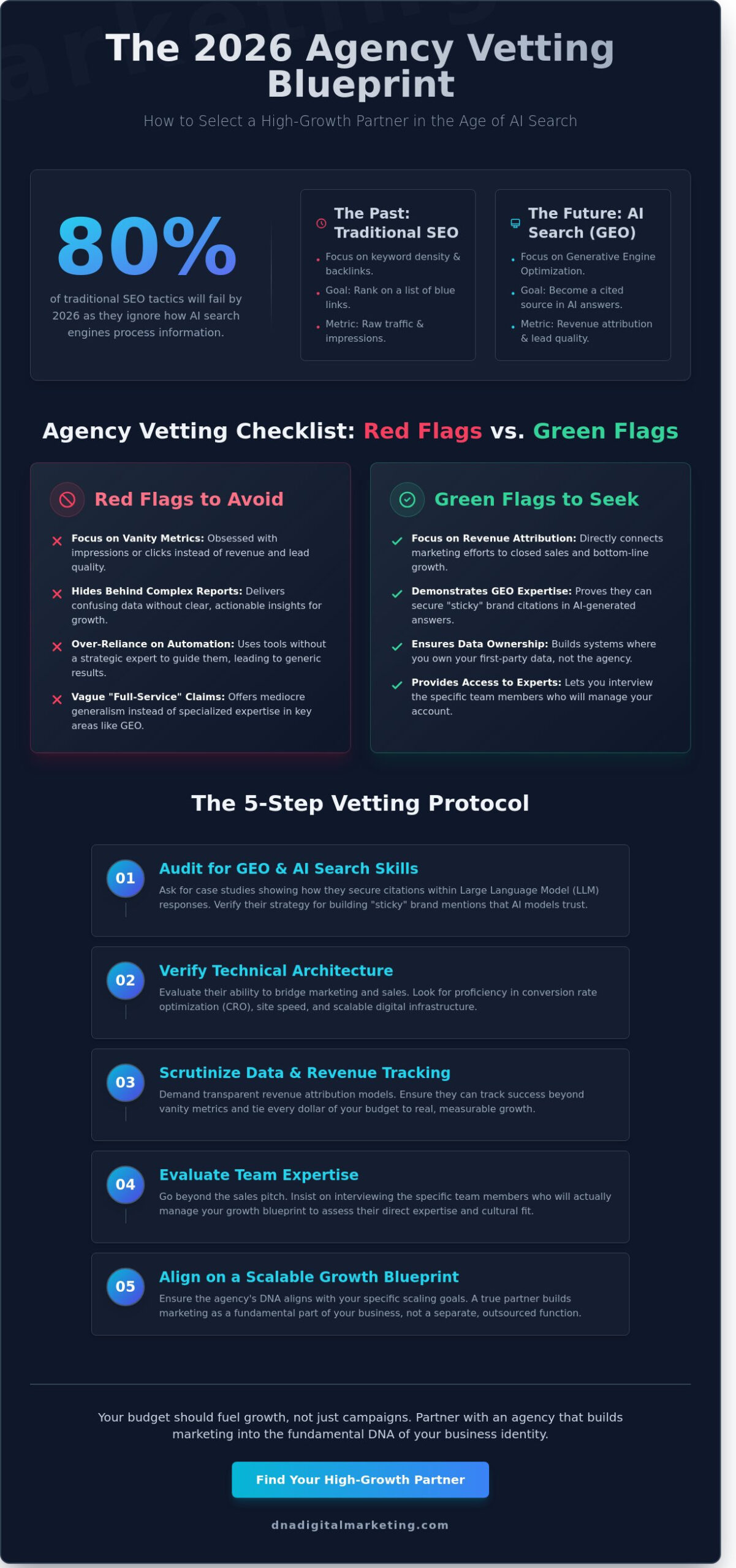
The 5-Step Vetting Protocol: From Discovery to Partnership
To master how to vet a digital marketing agency, use a five-step protocol. Prioritize data transparency and strategic blueprints over generic pitches. This systematic approach filters out low-performing vendors and identifies partners capable of driving measurable revenue growth.
Selecting the right partner requires a clinical approach to their methodology and performance history. DNA utilizes 15+ years of marketing communications expertise to guide this selection process. Follow these five steps to ensure your marketing evolution stays on track:
- Step 1: Conduct an initial audit of past performance. Because vanity metrics mislead, you should verify results tied to actual revenue. Look for a track record of scaling businesses in your specific sector.
- Step 2: Interview the specific team members. This prevents a “bait and switch” where senior leaders sell the account while juniors execute the work. You need to know the experts managing your daily strategy.
- Step 3: Analyze their inbound content marketing. If an agency don’t produce high-quality, authoritative content for themselves, they won’t do it for your brand. Check their technical depth and search visibility.
- Step 4: Request a customized growth blueprint. Instead of a template, demand a data-backed solution for your specific market challenges. A true partner provides a roadmap for long-term scalability.
- Step 5: Review the contract for clear exit clauses. Ensure the agreement allows your strategy to evolve. Look for 30-day or 60-day notice periods that protect your business interests if performance targets aren’t met.
Analyzing Case Studies and Proof Points
When learning how to vet a digital marketing agency, you must look beyond the surface of their portfolio. Look for long-term client relationships rather than high-churn accounts. Specifically, identify clients who have stayed with the firm for 3+ years. Verify that case study results correlate with revenue, not just traffic. For example, a 40% traffic boost is useless without a corresponding rise in sales. Contact references to ask about the agency’s proactive communication and problem-solving skills.
The Virtual Marketing Team Model
A virtual marketing team provides the agility needed for modern business evolution. This model integrates external experts directly into your internal culture. Consequently, the agency acts as a proactive extension of your brand identity. They don’t just fill a role; they drive the core strategy. This partnership ensures your marketing DNA remains strong and adaptable. An external team should feel like an internal department that is obsessed with your ROI.
Q1: How do I verify the authenticity of an agency’s case studies?
A: Ask for specific revenue-linked data and request direct contact information for the client references mentioned in the study to confirm the numbers.
Q2: What is the benefit of a virtual marketing team over a traditional firm?
A: Virtual teams provide greater flexibility and integrate more deeply into your internal culture, acting as a proactive brand extension rather than a distant vendor.
Q3: Why is a customized growth blueprint better than a standard pitch?
A: A blueprint addresses your unique market challenges with data-backed solutions, whereas a generic pitch relies on one-size-fits-all tactics that often fail to scale.
Q4: What should I look for in a marketing contract exit clause?
A: Look for clear 30-day or 60-day notice periods that allow you to pivot or terminate the relationship if specific performance targets aren’t met.
Q5: How does an agency’s own content marketing impact their credibility?
A: High-quality content demonstrates their technical depth and ability to rank for competitive terms, proving they can execute the same strategies for your business.
DNA Digital Marketing provides specialist expertise in SEO, AEO, GEO, and digital marketing services for small to medium-sized companies to ensure your brand remains sticky in a competitive market.
#DigitalMarketing #SEO #AEO #GEO #BusinessGrowth #MarketingStrategy #DNADigital
Why DNA Matters: Aligning Your Marketing Blueprint for Scalable Growth
To learn how to vet a digital marketing agency effectively, you must look for a partner that treats your growth as an internal evolution. DNA Digital Marketing utilizes a 15-year proven methodology to align your brand identity with data-driven strategic execution for repeatable, scalable results. Because we understand that marketing is a core business function, we avoid the surface-level fixes that plague many traditional agencies.
We leverage our 15+ years of marketing communications expertise to help you avoid common pitfalls. Instead of treating your strategy as an external add-on, we view it as an organic part of your business identity. Consequently, we focus on creating repeatable formulas. Success should never be a coincidence. Therefore, we base our success on a structured methodology that ensures your brand grows predictably. We invite you to transition from a vendor mindset to an Expert Partner relationship where shared ambition drives every decision.
Integrating Marketing into Your Business DNA
Successful evolution starts with internal clarity. Because of this, you should define your core business goals before your first consultation. When you align your brand identity with our strategic execution, the results become exponential. Specifically, we ensure your messaging resonates across all platforms. You can learn more about our foundational philosophy on our about DNA page. Ultimately, your marketing should feel like a natural extension of your team.
Starting Your Evolution
Next, you must prepare for a data-driven discovery session to map your future growth. This session serves as the blueprint for your digital transformation. We analyze your current metrics to identify precise opportunities for expansion. In fact, our discovery process uncovers the technical gaps that often hinder scalability. Because we prioritize data over guesswork, we ensure every campaign contributes to your long-term ROI. DNA Digital Marketing provides specialist expertise in SEO, AEO, GEO, and digital marketing for small to medium-sized companies ready to evolve their online presence.
Expert Q&A: Mastering the Agency Vetting Process
- How does a proven methodology prevent marketing failure?
A structured blueprint eliminates guesswork by using historical data and 15 years of industry insights to predict outcomes. - Why should a business define goals before a consultation?
Clear objectives allow an agency to align its technical execution with your specific growth targets from day one. - What is the difference between SEO and AEO?
Search Engine Optimization targets traditional search results, while Answer Engine Optimization focuses on providing direct responses for AI-driven queries. - How does an Expert Partner relationship improve ROI?
This collaborative model ensures that every marketing dollar supports long-term business evolution rather than temporary, isolated gains. - Why is data-driven discovery necessary for small companies?
Small to medium firms must maximize efficiency. Data identifies the exact pathways for the most profitable growth without wasting resources.
#SEO #AEO #GEO #DigitalMarketing #BusinessGrowth #MarketingStrategy #DNA
Secure Your Brand’s Evolutionary Future
Selecting the right partner determines your brand’s evolutionary path in a landscape dominated by AI Search. To succeed, you must prioritize technical blueprints over surface-level promises. Knowing how to vet a digital marketing agency requires a 5-step protocol focused on core DNA alignment. Consequently, your firm needs 15+ years of specialist expertise to navigate the shift toward GEO and AEO. Since 2009, our team has delivered data-driven blueprints that transform standard campaigns into organic growth engines. By evaluating technical core competencies now, you shield your ROI from future algorithm shifts. Instead, choose a partner that builds custom formulas for SMB scalability. Additionally, your business deserves a marketing engine that’s built to last. Therefore, prioritize transparency and technical depth during every discovery call. The 2026 landscape rewards those who integrate marketing into their brand’s fundamental identity. Schedule your free 2026 marketing consultation with DNA Digital Marketing.
Expert Q&A: Navigating the 2026 Vetting Landscape
What is the most critical technical skill for an agency in 2026?
Specifically, agencies must master Generative Engine Optimization (GEO) to ensure your brand remains visible within AI-generated search results and LLM responses.
How does a data-driven blueprint differ from a standard marketing plan?
A blueprint uses 15+ years of historical data to create a repeatable, scalable formula tailored to specific SMB growth goals. Consequently, it removes the guesswork from digital strategy.
Why is DNA alignment important when selecting a partner?
Because marketing shouldn’t be an external add-on; it must function as a fundamental, organic part of your business identity to drive long-term success.
What red flags should decision-makers look for during the vetting process?
Instead of accepting vague promises, watch for firms that fail to explain the technical mechanics behind their SEO, AEO, and conversion strategies.
How has the vetting process evolved for the modern landscape?
Ultimately, modern vetting prioritizes an agency’s ability to adapt to AI Search while maintaining a human-centric, collaborative energy that mirrors your internal team.
#DigitalMarketing2026 #SEOSpecialists #GEOMarketing #SMBGrowth #AgencyVetting #AEOStrategy #GrowthBlueprint
DNA Digital Marketing offers specialist expertise in SEO, AEO, GEO, and digital marketing for SMBs to ensure your growth strategy remains sticky.
Frequently Asked Questions
To effectively vet a digital marketing agency, evaluate their data transparency, technical ownership policies, and historical performance metrics. Focus on firms that provide a clear blueprint for growth and demonstrate a deep understanding of your brand’s digital DNA through 24/7 reporting. Selecting the right partner requires a results-oriented approach that prioritizes long-term scalability over short-term vanity metrics.
How long should it take to see results from a new digital marketing agency?
Expect SEO growth within 4 to 6 months, while PPC campaigns yield traffic within 72 hours. Consequently, our 15+ years of experience shows that organic evolution requires time to build authority. Thus, a healthy digital blueprint balances short-term wins with long-term scalability. Most businesses reach a performance plateau at 12 months without consistent optimization.
What is a reasonable budget for an agency managing SEO and PPC in 2026?
Industry data from the 2024 CMO Survey suggests that mid-sized firms allocate 13.6% of total revenue to marketing. Specifically, for 2026, experts project a monthly investment between $3,000 and $12,000 for integrated SEO and PPC management. Because market competition is rising, this budget ensures your brand maintains its digital DNA. Therefore, you should prioritize agencies that offer transparent allocation of these funds.
How do I know if an agency is actually doing the work they report?
Verify agency activity by requesting access to the Google Ads change history and Search Console performance logs. These platforms provide a digital paper trail of every optimization made to your core assets. Additionally, look for 24/7 access to a live reporting dashboard. If an agency hides its methodology, they likely lack the results-oriented focus needed for your growth.
What are the most important KPIs to track when vetting an agency?
Focus on Conversion Rate and Cost Per Acquisition (CPA) rather than vanity metrics like impressions or clicks. These numbers reveal the true health of your marketing ecosystem. When you learn how to vet a digital marketing agency, ask for their historical average CPA for your industry. Consequently, tracking these metrics ensures that your investment evolves into a profitable asset.
Should I hire a niche-specific agency or a generalist digital firm?
Choose a niche agency if your industry requires specific regulatory knowledge. However, select a generalist for broader cross-channel synergy. Generalist firms often apply successful blueprints from diverse sectors to spark innovation in your market. Because digital trends shift rapidly, an adaptable partner often provides better long-term scalability. Ultimately, the best choice depends on your internal team’s existing technical DNA.
What happens to my data if I decide to leave the agency?
You must retain full ownership of all accounts, including GA4, Google Ads, and your website domain. A professional firm ensures that your data remains your intellectual property even if the partnership ends. Therefore, review your contract for portability clauses before signing any agreement. This protection keeps your business’s growth history safe for future evolution.
#DigitalMarketing #SEO #AEO #GEO #GrowthMarketing #MarketingStrategy #DataDriven
DNA Digital Marketing provides specialist expertise in SEO, AEO, GEO, and digital marketing for small to medium-sized companies to ensure your brand’s long-term evolution.
