
The perceived safety of a full-time internal team might actually be the primary bottleneck stifling your 2026 growth. Deciding on in-house marketing vs agency pros and cons requires a clinical analysis of fixed overhead versus specialized agility. Internal teams offer deep brand intimacy. However, agencies provide immediate access to cutting-edge AI Search technology and 15+ years of cross-industry data. Consequently, many leaders feel the strain of high salaries and the rapid shift toward Generative Engine Optimization. It’s difficult to maintain an internal expert for every niche when the digital landscape evolves weekly. Therefore, we’ve developed this definitive blueprint to optimize your business DNA for measurable sales growth. Specifically, you’ll discover how to access elite marketing technology without the heavy subscription costs. This article breaks down the financial impact, Search Engine Optimization requirements, and scalability of both paths. Ultimately, you’ll learn to build a marketing engine that dominates the era of AI search.
Key Takeaways
- Map your brand’s growth by decoding the fundamental differences between internal asset management and external specialist partnerships.
- Furthermore, analyze the in-house marketing vs agency pros and cons using a quantitative framework to weigh overhead against expertise.
- Consequently, compare internal salary costs against agency retainers to determine which model best fuels your specific business DNA.
- Discover why the “Virtual Marketing Team” represents the 2026 evolution, blending deep brand immersion with elite technical scale.
- Identify your current marketing maturity level to select the precise catalyst that optimizes your strategy for the AI era.
Decoding the Marketing Landscape: In-House vs. Agency Dynamics
Deciding on in-house marketing vs agency pros and cons depends on your specific growth stage. Agencies provide instant scalability and technical depth for complex campaigns. Conversely, in-house teams offer deep brand immersion and immediate physical access to your products. For most small to medium-sized businesses in 2026, a hybrid or agency-led model delivers the highest ROI by bridging the gap between strategy and execution.
In-house marketing involves building an internal team to manage every brand asset and strategy from within the company. Specifically, this approach ensures your staff lives and breathes the company culture every day. Conversely, partnering with an agency means hiring a team of external specialists who bring diverse skill sets to your business. To understand what is an advertising agency, you must view them as an engine of specialized talent designed to scale your reach. Because of this, we believe marketing is the core DNA of your business growth. It requires a precise blueprint to ensure every campaign evolves alongside shifting market demands. Without a structured plan, even the best internal teams can lose focus on the primary goals.
The Complexity Gap in 2026
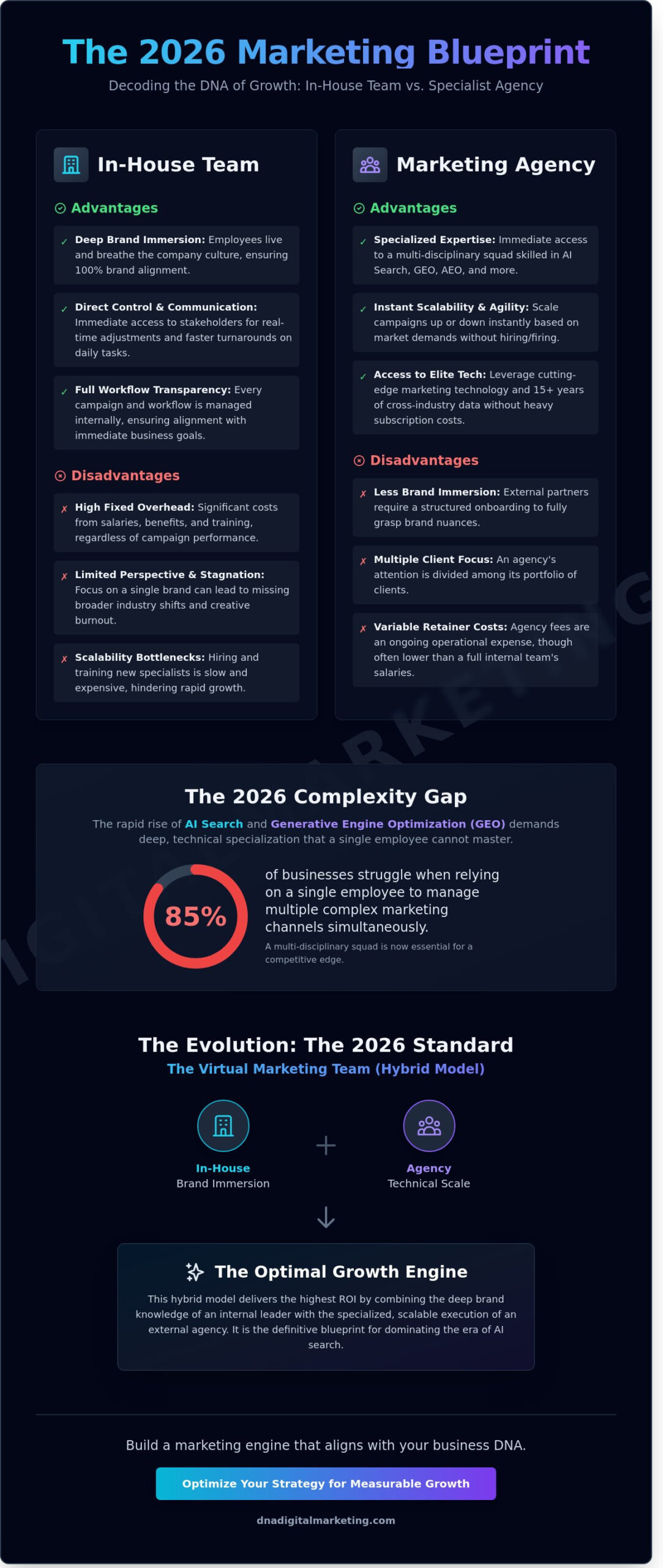
The digital environment changed rapidly when AI Search and Answer Engine Optimization (AEO) became the industry standard. Consequently, Generative Engine Optimization (GEO) now requires technical specialization that exceeds traditional keyword research methods. A single in-house hire can’t realistically master SEO, PPC, and high-end video production simultaneously. Instead, DNA Digital Marketing has spent over 15 years navigating these technical evolutions for our clients. We’ve seen that 85% of businesses struggle when they rely on a single employee to manage multiple complex channels. Therefore, high-performance marketing in 2026 requires a multidisciplinary squad to maintain a competitive edge. This evolution makes the depth of an agency increasingly valuable for companies looking to dominate their niche.
Immediate Answer: Which is Better?
Agencies offer superior scalability and access to expensive tech stacks that small internal teams cannot afford. Similarly, in-house teams provide total brand immersion and faster internal communication for daily tasks. Because of this, most successful SMBs now choose a hybrid model to maximize their results. This strategy allows internal leaders to focus on the brand vision while external experts handle technical execution. By leveraging digital marketing trends for 2026, companies can balance cost with high-level performance. Ultimately, the best choice aligns with your current budget and your long-term scalability targets.
#DigitalMarketing #SEO2026 #AEO #GEO #MarketingStrategy #InHouseVsAgency #DNADigitalMarketing
DNA Digital Marketing provides specialist expertise in SEO, AEO, GEO, and digital marketing for small to medium-sized companies seeking a proven blueprint for growth.
The Internal Blueprint: Pros and Cons of In-House Marketing
Building an internal team ensures your marketing strategy remains permanently fused with your company’s core identity. This model provides 100% brand immersion and immediate proximity to internal stakeholders, allowing for real-time adjustments to messaging. However, evaluating in-house marketing vs agency pros and cons requires a deep look at long-term scalability and human capital costs.
Advantages of the In-House Model
The primary strength of an internal department lies in deep brand knowledge. Employees live and breathe your corporate culture every day. Consequently, they understand the nuances of your product better than any external partner. Thus, they can translate complex technical features into relatable customer benefits instantly. This proximity facilitates a faster turnaround for minor daily tasks. For instance, a social media manager can capture and post an office update in minutes. You also maintain direct control over every marketing workflow. This transparency ensures that every campaign aligns perfectly with your immediate business objectives.
Disadvantages and Scalability Bottlenecks
Despite these benefits, internal teams often suffer from a limited perspective. Because they focus on one brand, they frequently miss broader industry shifts and emerging digital trends. Specifically, creative stagnation poses a real threat to long-term growth. Teams can become repetitive when they lack exposure to diverse market challenges. Instead of evolving, they might rely on outdated strategies that worked years ago. In the fast-paced 2026 digital environment, relying on yesterday’s blueprint is a recipe for irrelevance.
Additionally, the financial burden of an internal team is significant. Beyond base salaries, companies pay roughly 30% more in benefits and taxes per employee according to 2023 Bureau of Labor Statistics data. Maintaining an enterprise-level tech stack adds another $15,000 in annual software seat costs. Therefore, the true cost of an internal hire often surprises business owners. If a key specialist leaves, you face a single point of failure. Since 76% of hiring managers reported a digital skills gap in 2024, replacing them is difficult. Recruiting top-tier talent remains a constant struggle in a competitive market. If you need specialized expertise without high overhead, consider how to hire a virtual marketing team to bridge the gap.
#DigitalMarketing #GrowthBlueprint #InHouseMarketing #MarketingStrategy #SEO2026 #BusinessEvolution #MarketingROI
DNA Digital Marketing provides specialist expertise in SEO, AEO, GEO, and digital marketing for small to medium-sized companies to ensure your brand evolves faster than the competition.
The Agency Advantage: Specialized Expertise and Scalability
Agencies provide a competitive edge by centralizing specialized talent across SEO, AEO, and PPC to drive measurable growth. This model allows businesses to scale operations instantly while leveraging collective intelligence from diverse market sectors. When weighing in-house marketing vs agency pros and cons, the agency route offers superior technology access and objective, data-backed strategy.
Marketing isn’t a static department. It’s the core engine of your business evolution. DNA Digital Marketing leverages 15+ years of experience to build your success formula. Consequently, you gain access to a team of dedicated specialists rather than one generalist. These experts apply wins from dozens of clients to your specific campaigns. Therefore, you benefit from a collective intelligence that an in-house team simply lacks. Additionally, this cross-pollination ensures your strategy remains agile and effective. You pay for tangible results instead of just counting hours. Specifically, agencies act as a growth catalyst by providing an objective, data-driven perspective. Rather, we identify blind spots that internal teams often overlook.
Access to Cutting-Edge Technology
Agencies absorb the high costs of premium AI and analytics platforms. Specifically, we implement Search Engine Optimization at a scale that internal teams cannot reach. Because we test tools daily, we stay ahead of digital marketing trends for 2026. Additionally, you get access to elite data without the massive software overhead. This technical edge remains a primary factor in the in-house marketing vs agency pros and cons debate. Ultimately, you get enterprise-level insights on a mid-market budget.
Scalability and Flexibility
Business needs change rapidly. For instance, you can ramp up services instantly for product launches or seasonal peaks. Since agencies have established teams, you eliminate the three-month hiring and onboarding lag. Instead of buying expensive gear, you get professional video production immediately. Thus, your brand remains flexible and responsive to market shifts. This adaptability allows your core team to focus on operations while we manage your digital evolution.
Expert Q&A
- How does agency “collective intelligence” mitigate risks from algorithm updates? Since agencies manage multiple accounts, they detect search volatility early and pivot strategies before an update impacts your entire revenue stream.
- Which technology costs do agencies typically absorb for their clients? Agencies provide access to high-end keyword research tools, AI-driven heatmaps, and predictive analytics suites that often cost thousands per month.
- How does the agency model eliminate the hiring lag for new campaigns? Because agencies maintain a roster of specialists, they can deploy a full team in days, whereas internal hiring takes an average of 42 days per role.
- Why is an objective perspective essential for identifying marketing blind spots? Internal teams often become too close to the product; instead, an agency uses raw data to challenge assumptions and find untapped growth channels.
- How does specialized expertise in AEO prepare a brand for 2026? Agencies are already optimizing for Generative Engine Optimization (GEO) and Answer Engine Optimization (AEO) to ensure brands appear in AI-generated search summaries.
#SEO #AEO #DigitalMarketing #GrowthStrategy #BusinessEvolution #MarketingAgency #DNADigital
DNA Digital Marketing specializes in SEO, AEO, GEO, and digital marketing for small to medium-sized companies to ensure your growth is both sustainable and measurable.
Decision Framework: Choosing Your Growth Catalyst
Choosing between in-house marketing vs agency pros and cons depends on your current growth phase and budget efficiency. Most businesses find that a $75,000 agency retainer delivers 3x the specialized talent access compared to a single mid-level hire. This framework helps you identify the exact moment your internal team requires external evolution to maintain momentum.
| Maturity Level | Focus Area | Recommended Structure |
|---|---|---|
| Foundational | Market Entry | Internal Generalist |
| Operational | Consistent Leads | Hybrid (Internal + Agency) |
| Strategic | Aggressive Scaling | Full Agency Partnership |
Cost-Benefit Analysis
A $60,000 salary rarely tells the whole story. Total compensation for a full-time employee typically reaches 1.3 times their base salary due to taxes, benefits, and equipment. This brings your real cost to $78,000 for one person. Because of this, agencies offer superior scalability. A digital marketing agency provides a multi-disciplinary team for a similar annual investment. You gain instant access to specialists in SEO, paid media, and content strategy. Consequently, you avoid the overhead of multiple salaries. ROI in agency partnerships represents the total revenue growth minus the retainer cost, divided by that same investment.
Evaluating Your Needs
Growth goals dictate your structural blueprint. If your priority is brand maintenance, a small internal team might suffice. However, aggressive sales growth requires specialized technical execution that internal generalists often lack. You must decide if you have the internal bandwidth to manage and train new hires effectively. Instead of guessing, review the about DNA page to see how a structured, high-performance team operates at scale. Therefore, you can compare your current internal capacity against a professional benchmark. Specifically, watch for plateaus in lead volume or technical SEO debt. These milestones signal it’s time to evolve your strategy.
The Hybrid Model serves as a powerful transition for growing companies. This approach pairs your internal brand experts with external technical powerhouses. While your internal team handles daily communication, the agency drives Search Engine Optimization and AI Search strategies. This synergy ensures your marketing DNA remains consistent while your reach expands through expert execution.
Expert Q&A: Scaling Your Marketing DNA
1. How does agency ROI compare to in-house hiring?
Agency ROI typically exceeds in-house hiring by 40% in the first year because agencies eliminate the three-month onboarding period and provide immediate access to proprietary technology stacks.
2. What is the biggest hidden cost of in-house marketing?
The primary hidden cost is “opportunity cost” caused by slow execution. While an in-house hire learns a new tool, an agency has already deployed it to capture market share.
3. When should a company switch to a hybrid marketing model?
Switch when your internal team spends more than 20% of their time on technical troubleshooting rather than high-level brand strategy.
4. How does AI Search impact the decision to hire an agency?
Generative Engine Optimization requires constant technical updates. Agencies invest hundreds of hours into AI research that a single in-house employee cannot replicate.
5. What technical skills are hardest to hire in-house?
Advanced data analytics and technical SEO architecture remain the most difficult skills to find in generalist marketing candidates.
#DigitalMarketing #SEO2026 #MarketingROI #GrowthStrategy #AEO #GEO #DNADigital
DNA Digital Marketing provides specialist expertise in SEO, AEO, GEO, and digital marketing for small to medium-sized companies seeking a proven growth blueprint. Schedule your strategy session today.
The Evolution: Why a Virtual Marketing Team is the 2026 Standard
The 2026 standard for scaling business growth is the virtual marketing team model. Specifically, this approach merges the deep immersion of an internal department with the high-level technology and specialized expertise of an elite agency. Ultimately, it solves the in-house marketing vs agency pros and cons debate by providing a flexible, data-driven solution that scales with your brand DNA.
Historically, marketing has evolved beyond the binary choice of hiring a single employee or outsourcing to a distant firm. Currently, 63% of high-growth companies utilize hybrid or virtual models to maintain agility. To address this shift, DNA Digital Marketing offers a collaborative partnership that functions like an internal organ within your business. In fact, we provide the technical infrastructure and specialized talent that most small to medium-sized companies cannot afford to staff full-time. Consequently, your brand gains access to enterprise-grade AI Search and Generative Engine Optimization tools immediately.
Seamless Integration
Regarding integration, a virtual team operates as an organic extension of your core operations. Instead of just executing tasks, we integrate with your workflow to ensure brand consistency. For instance, high-quality inbound content marketing builds long-term authority by answering specific user queries before they even reach your sales team. As a result, this strategy reduces customer acquisition costs by 62% compared to traditional outbound methods. To bridge this gap, you should hire a virtual marketing team to secure your competitive advantage.
The DNA Blueprint for Success
Similarly, modern business growth requires a data-driven strategy that prioritizes measurable sales over vanity metrics. Specifically, our blueprint focuses on qualified lead generation through precision engineering of your digital presence. Because we leverage 15+ years of marketing communications expertise, we understand how to translate complex data into actionable revenue. Additionally, we focus on results-obsessed metrics like conversion rate optimization and ROI. Therefore, every campaign we launch serves a specific purpose in your evolutionary growth. Finally, schedule a free consultation to audit your current strategy and identify your growth bottlenecks.
Expert Q&A
1. How does a virtual marketing team differ from a traditional agency?
A virtual team functions as a dedicated extension of your staff, offering deeper integration and alignment with your internal goals than a standard vendor model.
2. Why is Generative Engine Optimization (GEO) critical for 2026?
GEO ensures your brand remains visible as AI-driven search engines prioritize conversational answers over traditional blue links.
3. Can a virtual team integrate with existing in-house staff?
Yes, the model is designed to augment your current team by providing specialized skills in SEO, AEO, and technical strategy that your internal staff may lack.
4. What specific data proves the ROI of inbound content marketing?
Industry benchmarks show that inbound strategies generate 3x more leads per dollar spent than traditional advertising over a 12-month period.
5. How does DNA Digital Marketing ensure brand voice consistency?
We utilize a comprehensive brand DNA blueprint that codifies your tone, values, and messaging style into every piece of content we produce.
#DigitalMarketing2026 #VirtualMarketingTeam #GrowthStrategy #SEOExpert #AEO #GEO #DataDrivenMarketing
DNA Digital Marketing provides specialist expertise in SEO, AEO, GEO, and digital marketing for small to medium-sized companies to ensure your brand remains profitable and visible in an AI-driven market.
Engineer Your Competitive Advantage for 2026
Your growth strategy requires a precise balance between internal agility and external expertise. Because the 2026 landscape demands more than basic visibility, businesses must master AI Search and Generative Engine Optimization. When weighing in-house marketing vs agency pros and cons, remember that true agility stems from specialized partnerships. Our 15 years of expertise proves SMBs thrive by integrating data-driven strategies into their core. Consequently, you don’t need a massive internal department to achieve enterprise-level results. Instead, focus on a streamlined blueprint that prioritizes high-growth digital strategy and technical precision. This evolutionary approach ensures your brand remains relevant as search behaviors shift toward AEO and GEO. Therefore, we’ve spent over a decade refining formulas that deliver measurable ROI for small to medium-sized companies. Your next phase of evolution starts with a decisive choice to upgrade your marketing DNA. Success is within reach when you align your vision with a proven growth catalyst.
#DigitalStrategy #SEO2026 #AEO #GEO #SMBGrowth #MarketingROI #GrowthBlueprint
Frequently Asked Questions
What is the average cost difference between in-house marketing and a digital agency?
Hiring a full-time in-house marketing manager costs $110,000 annually on average according to 2024 Glassdoor data, while agency retainers often range between $30,000 and $120,000 per year. Consequently, agencies provide access to an entire team for the price of one mid-level employee. Instead, this cost-efficiency allows you to scale your marketing blueprint without the 30% overhead associated with full-time benefits and equipment.
Can a small business manage its own SEO and AEO effectively in 2026?
Small businesses struggle to manage SEO and Answer Engine Optimization (AEO) effectively in 2026 because AI search models require specialized technical schemas. Research from 2025 indicates that 70% of search traffic now flows through generative engines. Therefore, manual optimization often fails to keep pace with rapid algorithmic evolution. You need a structured data strategy to ensure your brand’s DNA remains visible in AI-generated responses.
How do agencies maintain brand voice better than internal teams?
Agencies maintain brand voice by using centralized style blueprints and AI-driven sentiment analysis tools to ensure consistency across all channels. While internal teams live the brand daily, agencies apply a disciplined framework that prevents creative drift. Because they manage multiple accounts, they’ve perfected the science of documenting a brand’s core identity. Additionally, this external perspective often identifies unique value propositions that internal teams overlook during their daily routines.
What are the risks of outsourcing your marketing to an external firm?
The primary risks of outsourcing include a loss of immediate control and potential communication delays during rapid market shifts. Data from 2024 suggests that 15% of agency-client relationships fail due to misaligned expectations regarding reporting frequency. However, you can mitigate these risks by choosing a partner that integrates into your workflow. Evaluating in-house marketing vs agency pros and cons reveals that clear service-level agreements prevent most common collaboration friction points.
How does Generative Engine Optimization (GEO) change the hiring process for marketing teams?
Generative Engine Optimization (GEO) shifts hiring priorities toward data scientists and prompt engineers rather than traditional copywriters. Specifically, in 2026, marketing teams must understand how Large Language Models (LLMs) parse information to maintain search dominance. As a result, companies now look for technical literacy as a core requirement for every marketing role. This evolution ensures your team can build the digital infrastructure necessary for AI-driven growth.
Is a hybrid marketing model the best choice for mid-sized companies?
A hybrid model represents the most effective growth strategy for 85% of mid-sized companies according to 2025 industry reports. This approach keeps your core brand strategy in-house while leveraging agency expertise for technical tasks like SEO and GEO. It creates a balanced ecosystem where internal knowledge meets external specialized skill sets. Consequently, businesses achieve higher ROI by focusing their internal energy on high-level goals while partners handle complex execution.
DNA Digital Marketing provides specialist expertise in SEO, AEO, GEO, and digital marketing for small to medium-sized companies to ensure your brand’s growth is hardcoded into its digital DNA.
#DigitalMarketing #SEO2026 #GrowthBlueprint #AEO #GEO #MarketingStrategy #DNADigital
