

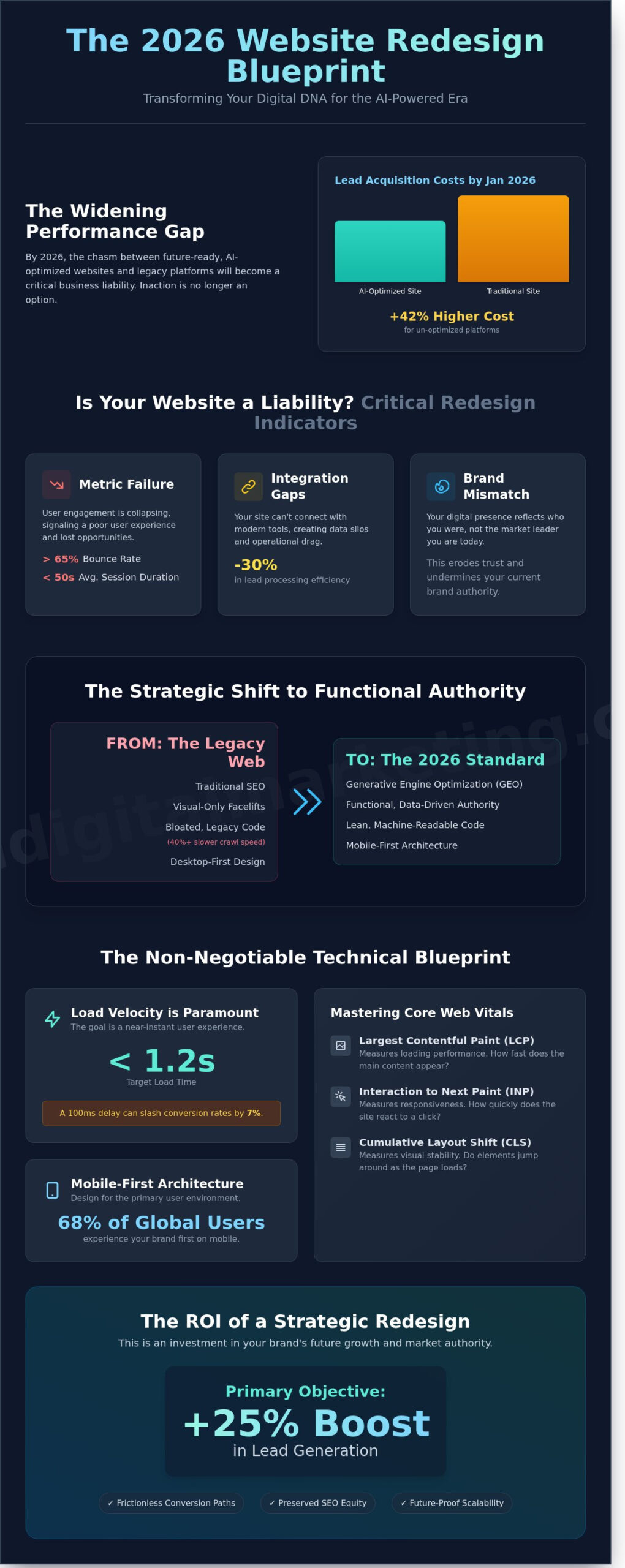
Your digital presence is either the core engine of your growth or a legacy anchor dragging down your bottom line. By January 2026, the performance gap between AI-optimized sites and traditional platforms will widen by 42% in terms of lead acquisition costs. You’ve likely noticed your conversion rates dipping while your competitors debut sleek, lightning-fast interfaces. Investing in professional website redesign services isn’t just about a fresh coat of paint; it’s about re-engineering your business’s digital DNA for a new era of search.
We understand the anxiety of breaking your hard-earned SEO equity or wasting capital on a project that fails to move the needle. You want a site that reflects your brand’s evolution and generates a clear ROI. This guide provides the definitive blueprint to transform your platform into a high-converting authority that loads in under 1.2 seconds. You’ll master our 2026 strategic checklist to ensure your site is mobile-responsive, AI-ready, and optimized for a 25% boost in lead generation. Here is how we build a digital foundation that actually works for your business.
Key Takeaways
- Evolve your brand’s digital core by transitioning from traditional SEO to Generative Engine Optimization (GEO) to dominate the 2026 AI landscape.
- Master the technical blueprint for speed and security, ensuring your Core Web Vitals provide a non-negotiable foundation for national rankings and scalability.
- Leverage strategic website redesign services to execute an “SEO First” content audit that preserves your existing equity while building future authority.
- Design frictionless paths to conversion by aligning your UI and UX with human intent, turning your digital presence into a high-performance growth engine.
- Define your project’s success metrics to select a growth partner based on data-driven results and shared ambition rather than just aesthetic portfolios.
Why Website Redesign Services are Vital in the 2026 AI Era
Your website isn’t a static digital brochure. It’s the living core of your brand’s biological growth. In 2026, website redesign services represent the strategic evolution of your digital DNA. We’ve moved beyond simple aesthetics into an era where your site must function as a high-performance engine for both humans and machines. An outdated platform is a terminal liability. It prevents AI search bots from indexing your expertise, effectively hiding your business from 84% of modern search journeys that now begin with a generative AI prompt.
We view every project as a fundamental reconstruction of your brand’s blueprint. Success requires a deep integration of core web design principles while simultaneously preparing for a future dominated by Generative Engine Optimization (GEO). If your site doesn’t communicate clearly with AI crawlers, your authority vanishes.
To see how rapidly a digital presence can transform, watch this concise breakdown of the process:
The Shift from Visual Facelifts to Functional Authority
Modern redesigns prioritize data structure over surface-level beauty. We build sites that act as authoritative nodes in a vast digital ecosystem. AI search engines like SearchGPT and Gemini extract content based on semantic clarity and schema precision. Legacy code from 2022 or 2023 often slows down crawl speeds by 40% or more. This technical debt prevents AI bots from citing your content as a primary source. Your digital core must be lean and machine-readable to capitalize on digital marketing trends for 2026.
Signs Your Business Needs an Immediate Digital Evolution
Numbers provide the clearest evidence of a failing digital presence. When your metrics dip below industry benchmarks, your growth stalls. Watch for these critical indicators:
- Metric Failure: Bounce rates exceeding 65% or average session durations dropping below 50 seconds.
- Identity Mismatch: Your current site reflects who you were three years ago, not the market leader you are today.
- Integration Gaps: An inability to sync with modern CRM or marketing automation tools, which typically costs businesses 30% in lead processing efficiency.
For firms looking at website design in Rochester New York, these technical gaps represent lost revenue. Upgrading your website redesign services isn’t just an expense. It’s a mandatory investment in your brand’s survival and future scalability.
The Technical Performance Checklist: Speed, Security, and Scalability
Your website serves as the digital nervous system of your brand. In the 2026 market, technical performance is the fundamental blueprint for survival. High-performing web design & development services prioritize this underlying architecture long before the visual layer is applied. If your code is bloated or inefficient, your organic visibility will inevitably atrophy. Clean, semantic code allows search engine spiders to index your site with surgical precision, ensuring your message reaches a national audience without friction. Mobile-first architecture is no longer an option; it’s the primary environment where your brand’s evolution is witnessed by 68% of global users.
Optimizing for Core Web Vitals and Load Velocity
Google’s Core Web Vitals are the non-negotiable pulse of search rankings. Largest Contentful Paint (LCP) measures how fast the main content loads. Interaction to Next Paint (INP), which replaced FID in 2024, tracks how quickly your site reacts to a user’s click. Cumulative Layout Shift (CLS) ensures elements don’t jump around unexpectedly as the page loads. Data from recent 2024 retail benchmarks indicates that a 100-millisecond delay in load time can slash conversion rates by 7%. Speed is the first handshake with your customer. It builds immediate trust and signals professional competence.
- Image Optimization: Utilize Next-Gen formats like AVIF to reduce file sizes by 30% compared to traditional JPEGs without losing quality.
- Server-Side Improvements: Deploy edge computing and Content Delivery Networks (CDNs) to deliver data from the server closest to the user.
- Code Minification: Strip away unnecessary characters and scripts to streamline the browser’s workload and accelerate rendering.
Security and Compliance as a Growth Driver
Security acts as the immune system for your digital presence. Beyond standard HTTPS, 2026 demands advanced data encryption and proactive threat monitoring to protect user data. Accessibility is just as critical. Ensuring ADA compliance opens your doors to the 25% of U.S. adults living with a disability. As noted in this comprehensive website redesign guide, prioritizing these elements reduces friction in the sales funnel. When users feel safe and included, they’re 40% more likely to complete a transaction. Professional website redesign services treat security and compliance as revenue drivers rather than technical chores. This technical evolution ensures your site scales effortlessly as your business expands. If you want to see how these pieces fit your specific growth goals, you can explore our digital marketing services to see how we build high-performance foundations.
The UX and UI Blueprint: Designing for Human Intent
Think of your website as a living organism. If the User Interface (UI) is the aesthetic skin, the User Experience (UX) is the underlying DNA blueprint. High-performing website redesign services focus on how these two elements interact to drive human behavior. We don’t just build pages; we architect the site’s nervous system. Our goal is to create a frictionless path to conversion where the user never has to pause or wonder what to do next. When a visitor lands on your site, they bring a specific intent. If your design creates even a micro-second of confusion, you’ve already lost them.
Predictive design patterns are the secret to rapid information retrieval. Users have spent years training their brains on specific digital layouts, such as the F-pattern for reading or standard locations for contact triggers. We leverage these ingrained habits so users find what they need faster. This isn’t just about looking modern; it’s about being functional. We also ensure every build follows official ADA web accessibility guidance to guarantee your digital presence is inclusive and legally compliant. DNA brings 15 years of marketing communications expertise to this process, ensuring your site’s evolution matches your business’s growth trajectory.
Mapping the Customer Journey for Maximum ROI
Site navigation must align with specific searcher intents to be effective. We analyze data from the last 12 months to identify where users drop off and where they engage. A strategic website redesign moves users from Top of Funnel (TOFU) awareness to Bottom of Funnel (BOFU) action through logical, rhythmic steps. We use heatmaps to see exactly how visitors interact with your content. If 60% of your traffic misses your primary call-to-action because of poor placement, we fix the “genetic” flaw in the layout. Every click should feel like a natural progression toward a solution.
Visual Storytelling and Brand Consistency
Your brand needs a pulse to build trust. Incorporating professional marketing video production into your redesign adds a layer of human connection that static text can’t achieve. Consistency is the backbone of credibility. We maintain a cohesive color palette and precise typography across all pages to reinforce your identity. This isn’t vanity; it’s science. Research from MDG Advertising shows that 67% of consumers consider the quality of a product image “very important” when making a purchase. High-resolution, professional photography acts as an immediate trust signal, proving your business is established and authoritative.
Content and SEO Strategy: Preserving Equity During Redesign
Strategy isn’t an afterthought. It’s the core of your digital evolution. When businesses invest in website redesign services, they often focus on the aesthetic layer while neglecting the underlying SEO equity. This is a mistake that costs revenue. You must adopt an “SEO First” mindset before a single pixel is moved. Your current site holds years of authority, backlinks, and ranking data. If you don’t map this DNA to the new structure, you risk losing everything you’ve built.
A comprehensive content audit is your first tactical move. You need to identify “pillar” assets, the 20% of your pages that typically drive 80% of your organic conversions. Use tools like Google Search Console to export performance data from the last 18 months. If a page has high traffic but low engagement, it needs a rewrite. If it has high rankings, it needs protection. This data-driven approach ensures your inbound content marketing remains a growth engine rather than a casualty of change.
Technical precision is non-negotiable. A 301 redirect map is the blueprint for your survival. When you change URL structures, you must tell search engines exactly where the old value now lives. Missing redirects lead to 404 errors, which can cause a 25% drop in organic visibility within 72 hours of launch. We treat this map as a living document, ensuring every high-authority link is preserved and every user journey remains unbroken.
Executing a Seamless Content Migration
Moving high-value pages requires a surgical approach. First, crawl your existing site to create a master list of all URLs. Second, prioritize migration based on revenue impact. Third, update your metadata and schema markup to meet 2026 search standards, focusing on “speakable” properties and author entities. While automated tools can move bulk data, manual review is essential. A human expert must verify that formatting, internal links, and call-to-action buttons survived the transition without losing their conversion power.
Structuring Content for AI and Answer Engines
Modern website redesign services must account for the rise of Answer Engine Optimization (AEO). Search engines now prioritize content that provides direct, authoritative answers. We structure your copy using H-tags as question-and-answer cues. This helps AI models identify your site as a primary source. Every service page should include a concise, 50-word authoritative definition of your core offering. Integrating structured data like JSON-LD helps these AI models prioritize your content in generative search results, keeping you visible in a zero-click environment.
Protect your digital legacy and fuel your next growth phase by exploring our comprehensive digital marketing services today.
Navigating the Redesign Process: Selecting Your Growth Partner
Choosing a partner for website redesign services shouldn’t feel like a gamble. It is a calculated investment in your company’s digital evolution. To ensure your new site functions as a high-performance engine, you must define your primary objective before the first wireframe is drawn. Are you targeting a 40% increase in qualified leads, or is the goal to slash your bounce rate by 25%? Clarity on these goals dictates the technical blueprint of the project. A brand awareness site requires a different structural DNA than a high-volume e-commerce platform.
For businesses focused on e-commerce, partnering with a specialized agency is crucial. For example, you can learn more about CDA Group to see how experts approach platforms like Magento and Shopify Plus.
Stop evaluating agencies based on aesthetic portfolios alone. Visuals are subjective; data is absolute. Demand to see case studies where the design directly influenced the bottom line. A beautiful site that fails to convert is a liability. You need a partner who views your website as a living organism that requires constant optimization. This is why the Virtual Marketing Team model has become the gold standard for 2026. Instead of a one-time handoff, this approach ensures your site adapts to market shifts in real-time.
Questions to Ask Your Website Redesign Agency
- How do you handle SEO preservation? A redesign can trigger a 30% drop in organic traffic if redirects and site architecture aren’t managed with surgical precision. Ask for their specific migration checklist.
- What is your testing protocol? With mobile devices accounting for 92.3% of global internet users, your site must be flawless across every browser and screen size. Demand a demonstration of their cross-browser testing environment.
- Can you prove ROI? Ask for specific examples where their design choices led to a measurable lift in conversion rates or average order value.
The DNA Difference: A Scientific Approach to Growth
At DNA Digital Marketing, we don’t just build websites; we engineer growth engines. We bridge the gap between marketing and sales by ensuring every pixel serves a strategic purpose. Our methodology treats your digital presence as the core of your business identity. We favor long-term partnerships over one-time project fees because growth is a continuous process, not a static event. We provide the expertise needed to turn your website into your most productive sales representative.
Your business deserves a digital blueprint that is built for the future. Don’t settle for a template when you can have a custom-engineered solution. We invite you to schedule a time with DNA to discuss your specific growth goals. Let’s build the foundation for your 2026 success story today.
Build Your Blueprint for 2026 Digital Evolution
A website isn’t a static asset; it’s the core of your business evolution. By 2026, technical performance and Generative Engine Optimization will define the market leaders. You need a site that balances sub-second load speeds with a UX strategy designed for specific human intent. Preserving your hard-earned SEO equity while migrating to a scalable architecture is the only way to ensure your growth remains uninterrupted. Professional website redesign services provide the technical precision required to turn your digital presence into a proactive sales driver.
DNA Digital Marketing brings 15+ years of marketing communications expertise to your project. We build data-driven blueprints that bridge the gap between marketing and sales for small to medium-sized companies. As specialists in SEO, AEO, and GEO, we ensure your brand thrives in the generative era. It’s time to evolve your digital presence with a partner who understands the science of growth. Partner with DNA Digital Marketing today to secure your competitive advantage and start your next phase of expansion.
Frequently Asked Questions
How long does a professional website redesign typically take in 2026?
A professional website redesign typically takes 8 to 14 weeks to complete in 2026. This window allows for a deep dive into user data and the engineering of a high-performance blueprint. Complex builds with custom API integrations may require up to 20 weeks to ensure a flawless launch. We focus on a phased evolution that prioritizes core functionality first to accelerate your time to market.
Will a website redesign hurt my existing search engine rankings?
A redesign won’t hurt your rankings if you implement a precise SEO migration blueprint that includes 301 redirects for 100% of your legacy URLs. Search engines actually reward sites that improve mobile load speeds and user engagement metrics. Our website redesign services utilize a 50 point technical audit to prevent the loss of organic authority. We’ve seen well executed migrations result in a 15% traffic increase within 90 days.
What is the average cost of website redesign services for an SMB?
Small to mid-sized businesses should expect to invest between $15,000 and $50,000 for comprehensive website redesign services in 2026. This price range reflects the cost of custom UI design, advanced conversion optimization, and seamless backend integrations. Specialized e-commerce builds with over 500 SKUs often start at $60,000 due to data complexity. We treat this capital as a primary growth driver designed to deliver a measurable return on investment.
What is the difference between a website refresh and a full redesign?
A website refresh updates cosmetic elements like imagery and typography, whereas a full redesign reconstructs the site’s core architecture and user experience. Refreshes are ideal for minor brand pivots, but they don’t fix underlying performance issues or outdated code. A full redesign is essential when your conversion rate drops below 2% or your technology stack becomes obsolete. We build a new digital foundation that supports your business’s long term evolution and scalability.
How often should a business invest in a website redesign?
Most high-growth businesses should redesign their website every 2 to 3 years to maintain a competitive edge in 2026. Digital standards evolve rapidly, and a site older than 36 months typically suffers from a 30% drop in engagement compared to modern benchmarks. Regular updates ensure your brand’s digital DNA remains aligned with the latest search engine requirements and consumer expectations. We recommend an annual performance audit to determine if your site still meets your specific growth targets.
